/ Atsushi Aizawa

Venue
Kyu Yamakano
《How The Wilderness Thinks》2025
About Works
[Curatorial Comment]

Shaped by childhood years spent in a satoyama (a semi-managed border zone where human habitation meets foothill forest), Atsushi Aizawa has long been drawn to the boundary where nature and human activity meet. Working with cast iron, industrial materials, and other human-made substances, he explores how matter is gradually reclaimed by natural processes over time. This large-scale installation is grounded in research Aizawa began in 2024 on silk as a material and on the history of its industry.
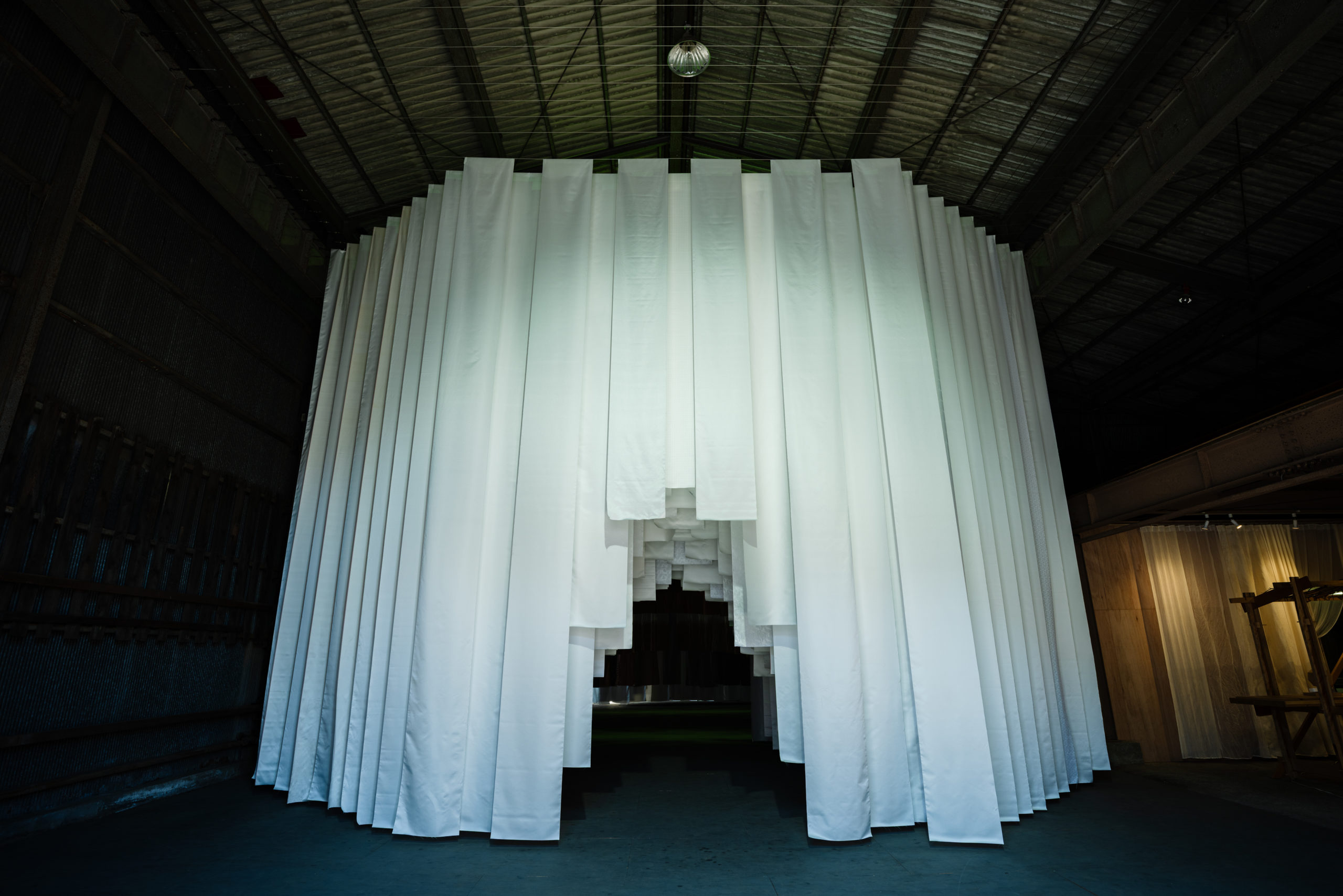
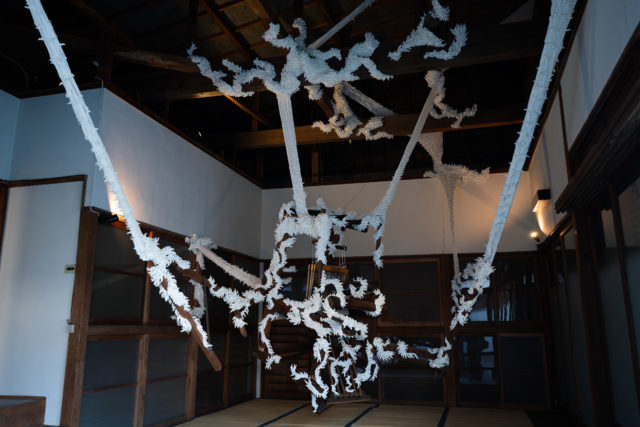
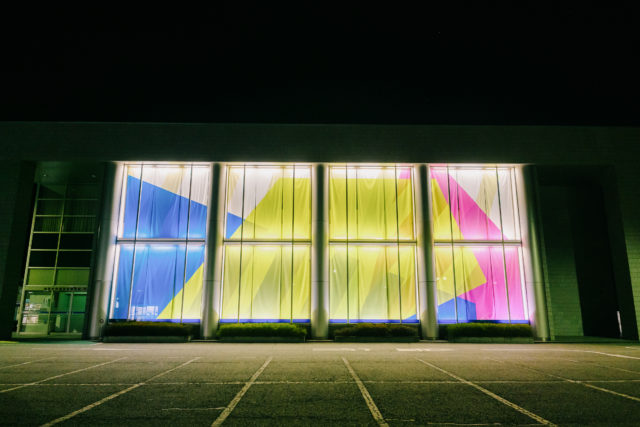
For this work, vast quantities of deadstock silk—once produced in abundance in Fujiyoshida—are suspended throughout the space in varying lengths, creating a cavern-like structure that viewers physically enter. More than 800 pieces of silk, their lower edges hand-dyed with the assistance of a local dyeing factory, are arranged to evoke the ridgelines of Mount Fuji. Aizawa notes that he was thinking of the tainai-meguri practiced by Fuji confraternities, a ritual of purification and rebirth, in which pligrims will pass through tree-shaped lava cavities formed when molten rock encased and later consumed fallen trees before their ascent of the mountain.
In Fujiyoshida, the mountain’s wild presence, the lives and labor of the people who have long responded to it, and the textile culture that developed alongside this environment have collectively shaped the character of the region. Aizawa’s installation suggests that these overlapping strata of time and activity may offer cues for imagining how the town might again be reborn.

[Artist Statement]

A vast number of deadstock fabrics collected in Fujiyoshida are suspended from above; their lower edges dyed in color. By varying the lengths of the fabric, the installation forms a cave-like space; the dyed sections overlap in moiré-like layers, producing intricate gradations of tone reminiscent of mountain ridgelines through which visitors walk.
This act of walking immerses viewers in the lightness and texture of the fabric, offering a sense of psychological comfort—as if enclosed within a cocoon. It also draws inspiration from the tainai jukei—lava cavities formed when molten rock engulfed standing trees, leaving behind hollow interiors after the wood burned away. These womb-like formations, found around Mount Fuji, became sacred sites within Fujikō faith, symbolizing purification and rebirth before the mountain ascent.
Fujiyoshida has been inhabited for over ten thousand years, its culture shaped by faith in Mount Fuji, the flow of spring and snowmelt water, and the fertile lava plateau formed by repeated eruptions. Silk was introduced to Japan about two millennia ago and developed uniquely here, its beauty and texture resonating with the Japanese climate, sensibility, and tactile awareness. In Fujiyoshida, this environment nurtured a rich silk culture, giving rise to Kai-ki silk and other textiles, closely tied to Fuji worship and the veneration of Konohanasakuya-hime, the Shinto goddess of Mount Fuji and protector of sericulture. The mountain’s pure spring water, ideal for dyeing and washing, further supported the town’s growth as a weaving center.
The raw dynamism of Mount Fuji’s nature formed a foundation for human reason and creativity, together shaping the region’s unique culture. Life around the mountain unfolds in gradations—its slopes and the human realm interwoven across layers of history and livelihood.
Having grown up in a rural mountain area surrounded by forests and fields, where life followed the rhythms of nature, I find deep resonance with Fujiyoshida’s history and way of life. Through its textile traditions and stories, I see not relics of the past but threads that carry this place toward the future, reflecting on the boundary where nature and human life meet.
Artist Profile
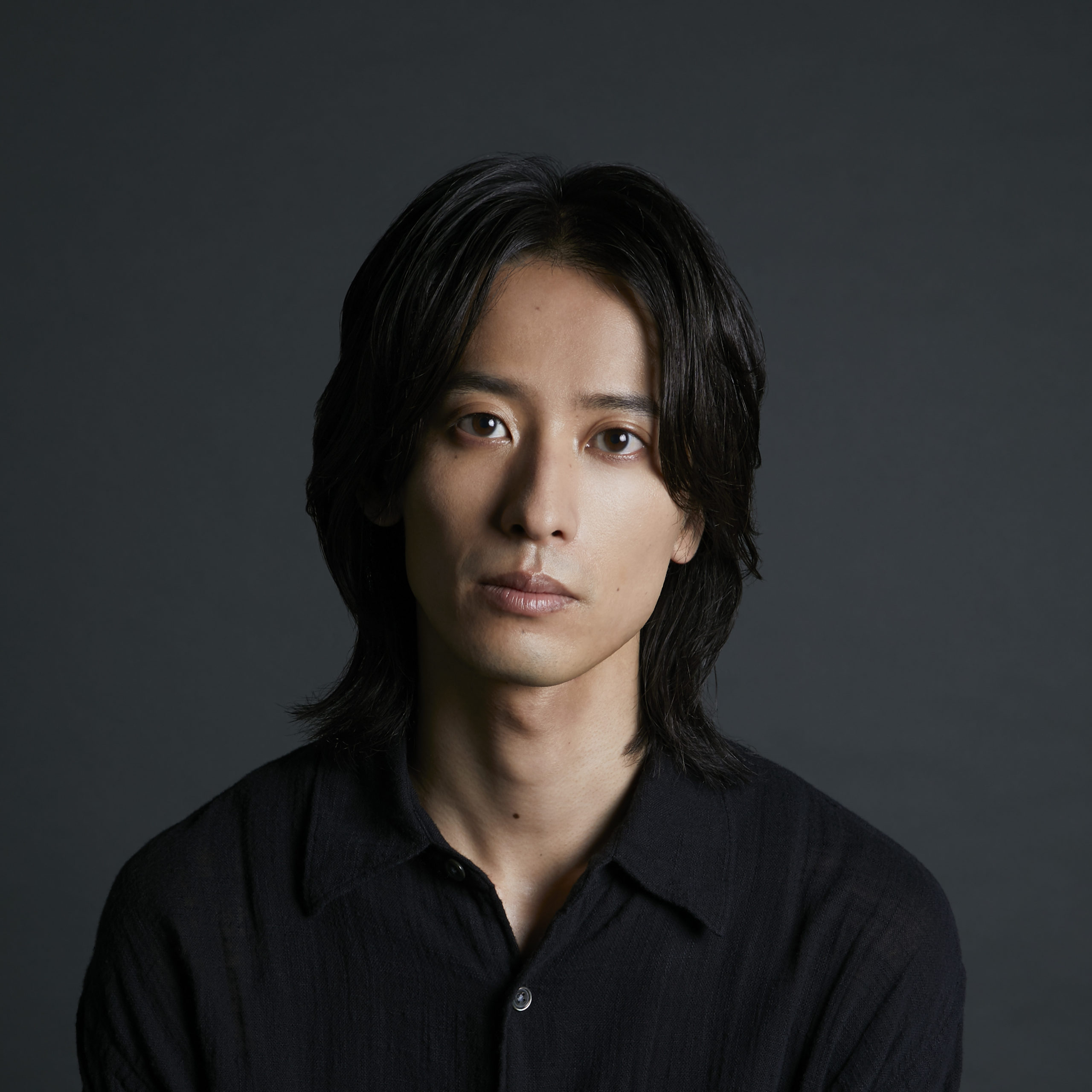
相澤 安嗣志 / Atsushi Aizawa

相澤 安嗣志 / Atsushi Aizawa

Born in 1991 in Kanagawa. Enrolled in the Department of Japanese Painting at Tama Art University’s Faculty of Fine Arts in 2011, and graduated from the Department of Information Design, Media Art Course, in 2015. Having spent his childhood in satoyama (rural areas where nature and human life coexist), he developed an interest in boundary zones where nature and humanity intersect, as well as in spaces where remnants of civilization and natural elements intermingle. His practice explores the interrelationship between the body, objects, and space, reflecting on the relationship between humans and things, and the ambiguous boundaries that connect them. Major exhibitions include The Texture of Boundaries (Yuvan, 2024), Centre - Empty (Ryōsokuin, 2022), The Discoveries from A Certain Fable (Courtyard Hiroo, 2019), and No Man’s Land (KANA KAWANISHI GALLERY, 2017).