/ Haruto Kamijo

Venue
(15)FUJIHIMURO
《forming patterns》2025
About Works
[Curatorial comment]

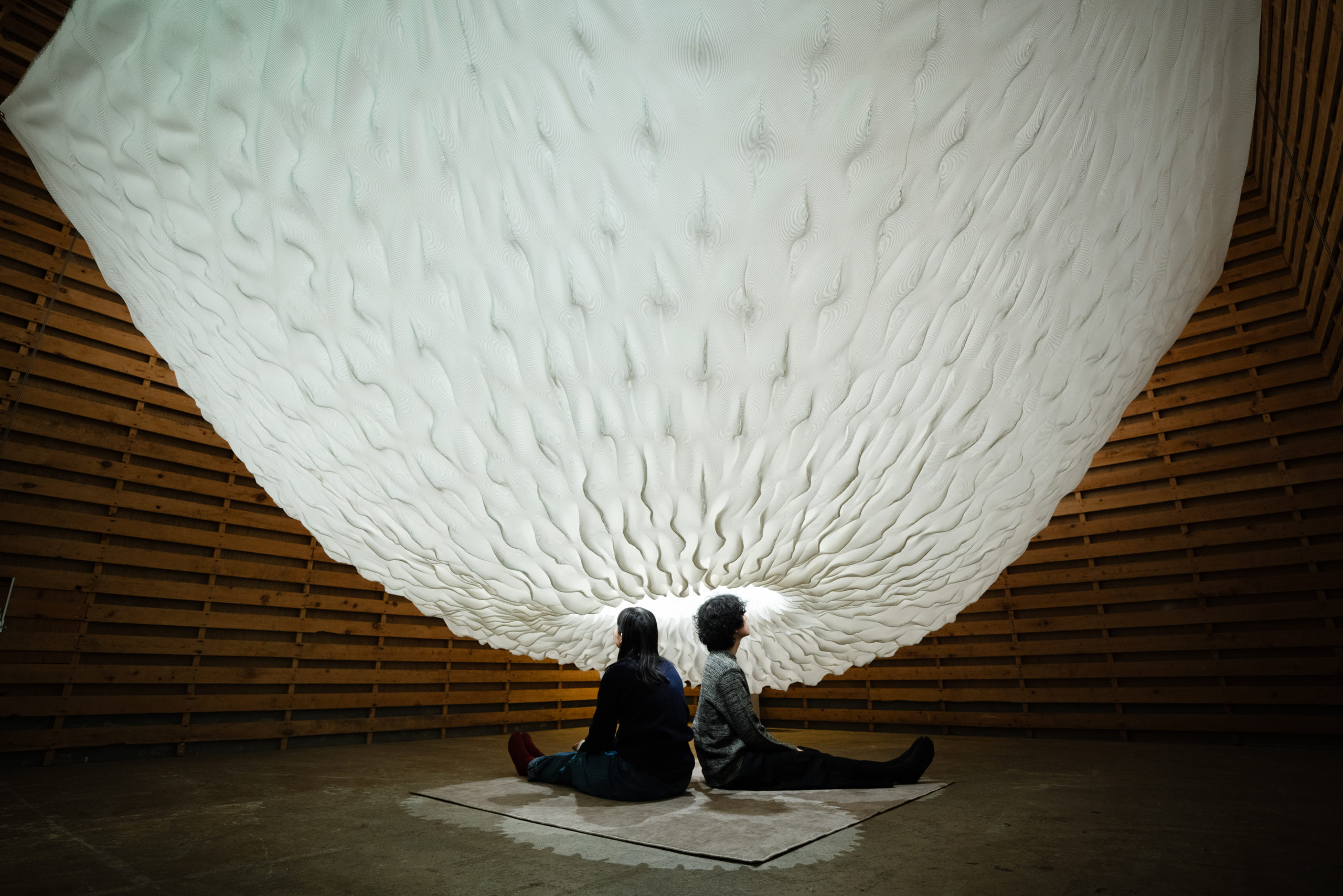
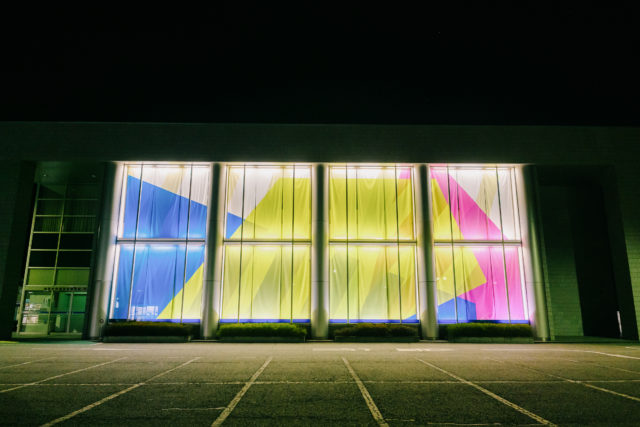
This work is a three-dimensional installation made with a transformable jacquard textile developed in collaboration with Makita Shoten, a long-established textile mill in Fujiyoshida. The fabric, patterned with a sequence of almond-shaped concentric forms, rises into relief not through sewing or post-processing, but through differential tension engineered directly into the weave structure. Kamijo uses this quality to treat the form of Mount Fuji as a sculptural format, constructing a space in which interior and exterior, and the “front” and “back” of the mountain, invert as the viewer’s position shifts.
Visitors enter by crouching on a carpet laid at the center and passing through an opening above. Overhead, an inverted mountain appears, producing the sensation of being taken into a different atmospheric layer. When the viewer exits and circles around to observe the work from outside, the “shadows” seen inside reverse into soft, outward-bleeding light. The cloth functions as a boundary membrane, allowing multiple viewpoints to coexist within a single spatial volume.
Kamijo notes that the work was inspired by Gustave Doré’s illustration of the “Empyrean” in The Divine Comedy. The Empyrean, the final destination of Dante’s journey at the furthest reach of the Paradiso, represents the source of the world suffused with divine light. The vision that emerges beyond the fabric membrane echoes this upward motion of the gaze, resonating with long-standing local beliefs that position Mount Fuji as the place closest to the realm of the divine.
Drawing together formal impressions of mountain ranges and natural forms observed during research in Fujiyoshida with the physical characteristics of textile, the work reconstructs the act of “looking at a mountain” through light, cloth, and the movement of the body.

[Artist Statement]

I pulled and bent the jacquard textile in my hands, observing it from different angles and considering the effects it produced. The fabric was woven with a pattern of almond-shaped concentric forms that, through the same principle by which flower petals open and grow, softly curled into three-dimensional relief. When exposed to light, the white cloth reflected a sharp, hard brightness on one side, and a gentle, translucent glow on the other.
From this dual quality of light emerged the sequence of the exhibition: upon entering the space, one first senses the tension of hard light, then gradually becomes enveloped in soft illumination. To create this enveloping condition, the fabric was shaped into a cylindrical form, stretched vertically to span the height of the room. Like a soap film drawn between two frames, the cylinder narrows at its center; positioned at eye level, this constriction lowers the bottom edge near the floor, so visitors must stoop to pass beneath it. Light is cast from the side of the fabric cylinder, while the tall ceiling of the ice chamber remains in darkness, heightening the contrast between the illuminated interior and its surrounding void.
This process was not an attempt to represent a conceptual image through material, but to organize the material in response to its spatial conditions. If one perceives the outline of Mount Fuji, the ritual of tainai meguri (the pilgrimage through a womb-like cave), the flow of clouds or subterranean streams, the almond-shaped folds as a feminine form, or the radiant enclosure of petals as Dante’s celestial rose, these are all afterimages—traces of vision itself, in which the human faculty of imagination reenacts its own origin.
Artist Profile
上條 陽斗 / Haruto Kamijo

上條 陽斗 / Haruto Kamijo

Born in Tokyo in 2000. Currently a doctoral student in the Department of Architecture, Graduate School of Engineering, The University of Tokyo. His practice explores forms generated through dynamic fabrication processes, bridging research in computational fabrication with the creation of works using transformable textiles. In 2024, he was selected for the MITOU Program, which led him to begin producing works with jacquard looms in Fujiyoshida.
Solo exhibition: forming patterns (TIERS GALLERY, Tokyo, 2025)
Selected group exhibitions include gyroid resonance (Spiral Garden, Tokyo, 2025) and CONNECTING ARTIFACTS 03 (Komaba Museum, Tokyo, 2023)