/ Hanna Saito

Venue
Kyu Yamakano
《Flowing Along and Beyond the Weave》2025
About Works
[Curatorial Comment]

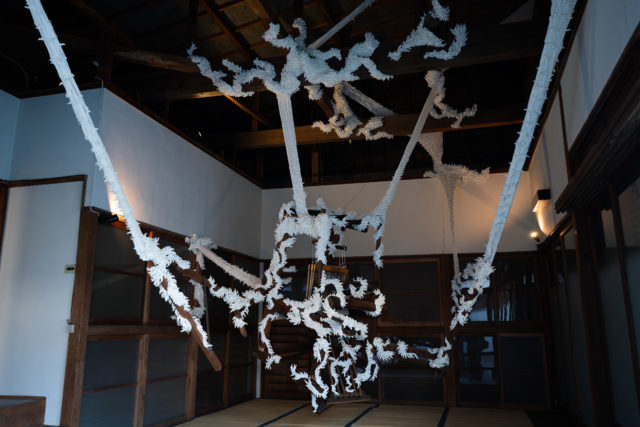
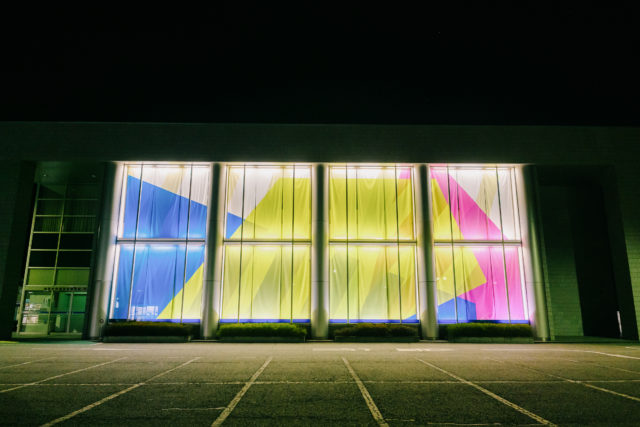
At the center of this former warehouse once used to store glass materials stands a scaffold tower, its upper basin filled with water pumped from the Mabori River just behind the venue. The water descends along several lengths of silk fabric, drawing ridgeline-like curves before dripping into vessels that were formerly used to collect leaks from the factory roof. Plasmodia of slime molds have been inoculated onto the silk, and as they migrate along the micro-channels formed by the flowing water, they consume pigmented nutrients and leave excreted residues as visible trajectories on the cloth.
Classified as plasmodial protists, slime molds alter their locomotion in response to temperature and humidity. Their activity slows on colder days, while warmer areas of the room produce heightened movement. A kerosene heater inside the factory creates localized thermal gradients, and much like people gravitating toward a heat source, the organisms are drawn to these warmer zones. Just as spring water from Mount Fuji carves innumerable channels across the foothills and has long supported patterns of human settlement, the water in this installation shapes, on a micro-scale, the environmental conditions in which the slime molds propagate. The weave of the silk behaves like a topographical surface, and the plasmodia navigate this structure by selecting their own routes, diverging or aligning with the textile’s pattern much like a river that follows or departs from the terrain.
During the days leading up to the exhibition, Saito stayed inside the factory to monitor and maintain the organisms, bringing in bedding and at times working throughout the night in temperatures that fell below freezing. That accumulated duration of cohabitation is inscribed as the traces now visible across the fabric. The trajectories of these small organisms, moving while withstanding the cold, parallel the days the artist spent inhabiting the space during production, offering viewers a basis for reading the rhythms of subsistence and daily life that have persisted in this region over many generations.

[Artist Statement]

On a length of brocade-patterned silk fabric, plasmodia of slime molds have been cultivated. As they move, consuming pigmented nutrients, their excretions trace visible trajectories across the cloth. Possessing a fluidic, amorphous body, the organisms sometimes follow the weave and pattern of the textile, and at other times diverge from them—like a river flowing along the terrain, overflowing and branching as it moves. The patterns formed by their motion make visible, over time, the subtle interactions that arise between the fabric and the living organisms.
Artist Profile
齋藤 帆奈 / Hanna Saito

齋藤 帆奈 / Hanna Saito

Born in 1988. Based in Tokyo and Yamanashi. Contemporary artist. She graduated from Tama Art University (Craft Department, Glass Course) with a bachelor's degree in Fine Art. After graduating, she joined metaPhorest (biological / bio-media art platform)in the Laboratory for Molecular Cell Network & Biomedia Art, at Waseda University as an artist and visiting researcher. Since 2021, she enrolled in the Doctoral Program in the Graduate School of Interdisciplinary Information Studies, The University of Tokyo (Yasuaki Kakehi Lab.) She’s creating artworks using scientific glass production techniques, organisms, organic matter, image analysis, etc.. She’s main themes are to reconsider the borders of nature/society, human/non-human, and the indivisibility of the expresser and the object of the expression at the interdisciplinary viewpoint.