/ Hirofumi Masuda

Venue
Kyu Yamakano
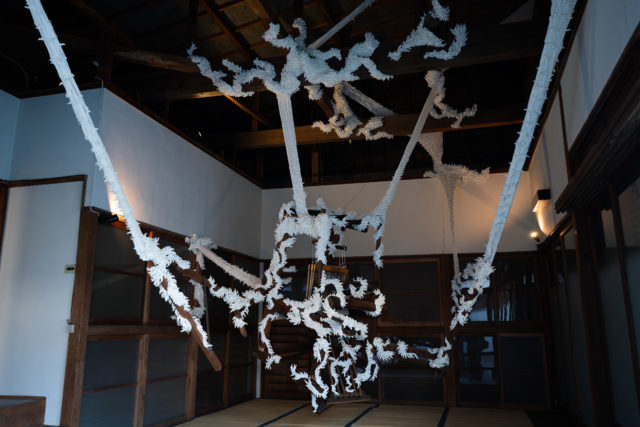
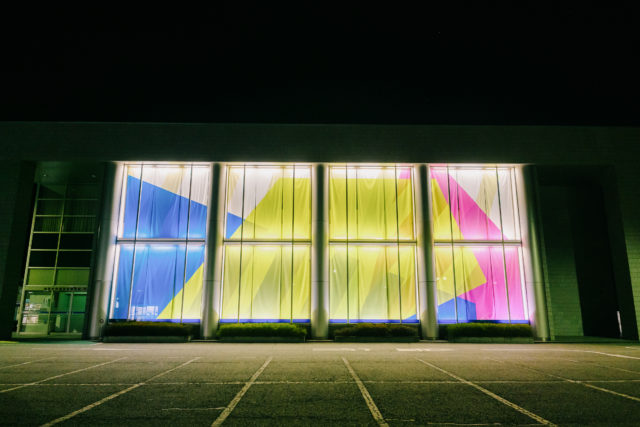
《White canopies 》2025
©NAKANO Yukihide
About Works
[Curatorial Comment]

Hirofumi Masuda is an artist known for his reconstructing of oral histories, esoteric traditions, and fragments of local narratives into a single fictive storyline grounded in wide-ranging regional research. Rather than relying on linear causality, his approach draws out images and impressions that resist easy articulation, using linguistic play and leaps of imagination to reveal new interpretive connections between disparate accounts.
This work interweaves two historical strands: the modern trajectory of Fujiyoshida’s silk industry—whose highly regarded Kaiki silk techniques led to the manufacture of silk parachute fabric for the military during World War II, before the industry shifted toward clothing and fashion—and the local legend of Jofuku, a figure said to have brought sericulture and weaving techniques to the region before transforming into a crane and descending upon this land after death. Using the color white as a narrative point of departure—white parachutes, white birds—the work links the image of Jofuku as a symbol of imported technologies and cultural transmission with the physical metaphor of descending by military parachute.
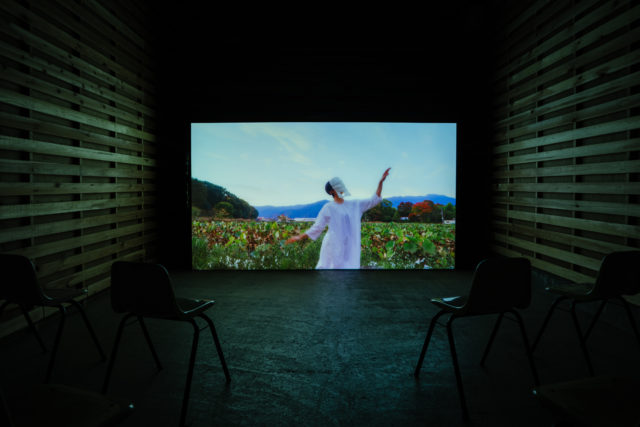
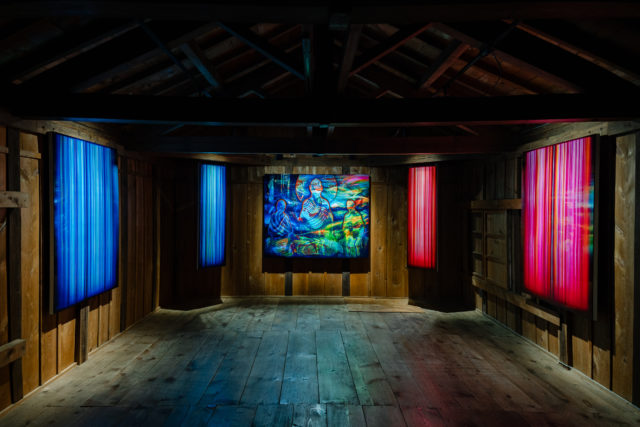
Across three synchronized yet intermittently diverging screens, meaning unfolds in layers. Within the exhibition space, elements such as paraglider harnesses, garment-pattern motifs, wartime documents, and loom sounds reminiscent of nationalist military marches function as material cues. A storefront window installation made from umbrellas modeled on parachutes further extends the work outward to the street. Visitors move through these components as they navigate the space, encountering the region’s history not as a single storyline but as a set of multidirectional currents that must be grasped through bodily memory rather than logical sequencing.

[Artist Statement]

On my second visit to Fujiyoshida, I learned that during the war, the town had produced silk fabric for military parachutes. The fact that parachutes were once made of silk was both surprising and deeply fascinating to me. As I researched further, I found that silk possesses all the essential qualities required for a parachute; lightness, strength, and a moderate air permeability that could control the airflow going into the textiles.
Documents preserved at the Industrial Technology Center’s Fuji Technical Support Division show that production of silk for the army began around 1934, and by 1943 silk fabric specialized for parachutes was being manufactured. It was likely that the advanced techniques developed through Kai-ki silk weaving were recognized by the military and led to the commissions.
Fujiyoshida, once known for Kai-ki silk and umbrella fabrics, has long inherited the craft of weaving beautiful and refined textiles. It is curious that in those same workshops, during wartime, fabrics to protect human lives were being made.
Clothing, after all, is meant to protect the body. The transformation of looms that once produced decorative, status-symbol textiles into objects designed to protect the user felt like a kind of return to origin. I also came across records and testimonies of parachutes and their fabric being repurposed into daily necessities after the war ended, helping people rebuild their lives. Over time, the form of the parachute itself evolved, now used in many different contexts for entirely different purposes—something that also drew my attention.
This work weaves together scenes of modern weaving mills, interviews with people who remember that period, archival research, and a visual composition that parallels umbrellas and parachutes. The film unfolds without narration, using only subtitles. The act of reading invites viewers to project their own memories and experiences, allowing space for personal interpretation—a quality I sought to preserve.
For the window installation, mass-produced umbrellas were used to reconstruct the moment a parachute opens and descends to the ground, as if in a shop window. Perhaps the weavers who made parachutes during the war also dreamed of the day they might again weave brilliant, ornamental fabrics.
Modern looms operate through countless interdependent components—if even one fails, a proper fabric cannot be produced. This image echoes the way individuals together form a functioning society. At the same time, this metaphor carries a faint sense of irony toward an era in which individuals were not permitted to ever stop.
Artist Profile
増田 拓史 / Hirofumi Masuda
©Hiromi Furusato

増田 拓史 / Hirofumi Masuda

Born in Japan in 1982. Based in Ishinomaki Miyagi since 2011. Masuda mainly focus on “Research and Archive” of the everyday life of the local community in order to find hints of local people and the unique essence of each community or region. Trying to find the source to make artwork through a month to a few months of research and expressing the results as the photograph, video work, publication, and workshop.
Current Exhibitions: “River to River 2022” (Gunma, 2022), “Romantic Route 3 Arts Festival” (Taiwan, 2019), “Reborn Art Festival 2017” (Miyagi, 2017), “CAFE in MITO R” (Art Tower Mito, Ibaraki, 2015), “JUMP” (Towada Art Center, 2015)

©Hiromi Furusato